Making Pinto's credit facility legible enough to actually use.

The 60 second Outcome Breakdown

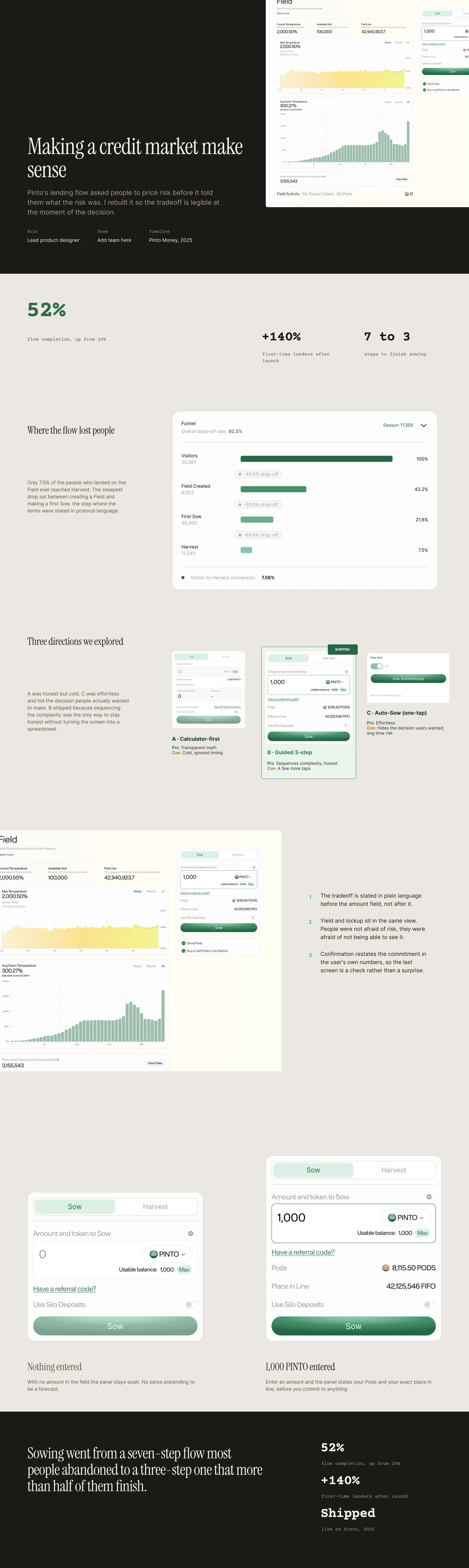
Pinto's Field is the protocol's core stability engine: users lend Pinto in exchange for Pods, a queued, non-guaranteed IOU that can pay back far more later. It was powerful and almost unused, because the mechanic was completely illegible. I found the opportunity in the data and the Discord, wrote the proposal to the founders, and drove the Sow flow from insight to ship.

Role

Team

Timeline

End to end Leade Designer

1 PM · 3 engineers · me

6 weeks, proposal → ship

+140% in first time lenders

7 → 3 steps to complete a sow

20% → 52% Sow completion rate

Two ways to put money into Pinto

The Silo

Savings. Deposit Pinto, earn yield when the protocol does well, withdraw anytime. Behaves the way people expect money to behave.

The Field

Credit. You Sow (lend) Pinto and receive Pods — IOUs that join a first-in, first-out Pod Line. Higher potential upside, but funds lock and payout isn't guaranteed.

Why it matters: when Pinto trades below target, Sowing is literally how the protocol pulls itself back to peg. Every abandoned Sow is a weaker peg — so this flow wasn't cosmetic, it was the growth lever.

Three Signals That Pointed at The Same Gap

  1. The data — The Field held the protocol's stability, yet only 20% of people who opened it ever finished a Sow. A cliff, not a leak.

  2. The qualitative — The same three questions repeated in Discord and support: “What's Temperature?”, “Why can't I withdraw?”, “When do I get paid?”

  3. The business — Below peg, Sow demand is how Pinto recovers. Abandoned Sows = a weaker peg. The gap was strategic, not cosmetic.

The proposal: a one-pager reframing the Field around a single guided action — Sow. Pitched it in our weekly; got a yes to prototype in 5 days.

Research: Fast, scrappy, and pointed

6 interviews: Two segments: yield hungry crypto-natives and cautious savers who came for the Silo.

Competitive teardown: How Aave, Olympus-style bonds, and on-chain T-bill products explain lockups, variable returns, and queues.

Mental-model map: Users think “deposit = savings.” Sow breaks three expectations at once: funds lock, return varies, payout is queued.

Key insight: Users didn't fear risk, they feared illegibility. Make the three unknowns: how much, how long, how likely — visible and honest, and they'll take the bet.

Framing: One problem, three principles

  1. Honesty over hype. Never hide the lockup or the “not guaranteed.” Trust is the conversion lever.

  2. Make the abstract concrete: Turn Temperature, Pods, and the Pod Line into things you can see and point at.

  3. One decision at a time: Sequence the complexity; don't dump all of it on the first screen.

HMW: let anyone lend into the Field with a clear, honest understanding of what they're giving up and what they might get back?

Collaboration: How I worked with eng & product

• Kicked off a 90-min FigJam sprint. PM brought protocol constraints, eng brought on-chain cost, I brought the user's open questions.

• Cracked the hard problem together — the “Morning Auction.” Temperature ramps up over the 10 minutes of each season, so Sowing earlier = a lower rate, but you race others for a finite amount of Soil. No pattern existed to copy.

• Pressure-tested 3 concepts in the same room. Each was scored live against eng feasibility and the PM's peg goals, so we killed weak ideas in minutes, not weeks

Three directions we explored

Outcome and Impact